

- Rivan has successfully achieved Gas Safety (Management) Regulations (GS(M)R) specification Synthetic Natural Gas (SNG) from its variable-flow Sabatier reactor.
- GS(M)R is the high-purity gas composition required to inject directly into the UK’s gas-grid.
- It was achieved across a range of varying reactant flow-rates through Rivan’s V2 Sabatier reactor.
- This milestone validates our variable solar-to-gas production pathway and paves the way for the first ever injection of Direct Air Captured (DAC) derived SNG into the UK’s gas grid.
On September 8th, 2025, Rivan Industries achieved GS(M)R specification Synthetic Natural Gas from its 100kW pilot-scale Sabatier reactor.
The UK has little domestic production of energy, with 44% of total energy usage being imported, split mostly between Natural Gas and Oil. Natural Gas is the most consumed fossil fuel in the UK, making up 37% of total energy usage, with the majority being imported. Combined with less than 2 weeks of full-usage storage available, The UK is continually exposed to market-fluctuations and vulnerable to energy-security issues, highlighted most recently during COVID and the Ukraine war.
Though the UK continues to deploy large-scale batteries and solar to electrify industries like road-transport and domestic heating, by 2040 ~ 40% of industrial energy demand will still use non-electric or low-carbon fuels. This includes industries that have:
(1) Molecular feedstock requirements (chemicals, steel, cement), or
(2) Energy density requirements that batteries can’t achieve (long-haul aviation).
Today, these industries are largely powered by natural gas or a derivative. To achieve 2050 net zero targets, we must rapidly find a commercially viable clean substitute is required. Rivan’s recent reactor performance is a massive step to forging that future into a reality.
This milestone is important for 3 reasons:
- Conversion specification
- The UK’s GS(M)R specifically is extremely stringent, requiring <0.1% H2 composition in the SNG produced. This is much tighter than in Europe, with Germany allowing 10% Hydrogen blend in SNG injected, highlighting the challenge of simply achieving this level of performance at all.
- Variable flow-rate
- The challenge is compounded by maintaining GS(M)R compliance as reactant flows vary. Changing H₂ and CO₂ flows affect catalyst loading, heating/cooling, pressure, sensing and control. To our knowledge, this level of variable-flow performance had never previously been demonstrated.
- In-house engineering and manufacturing
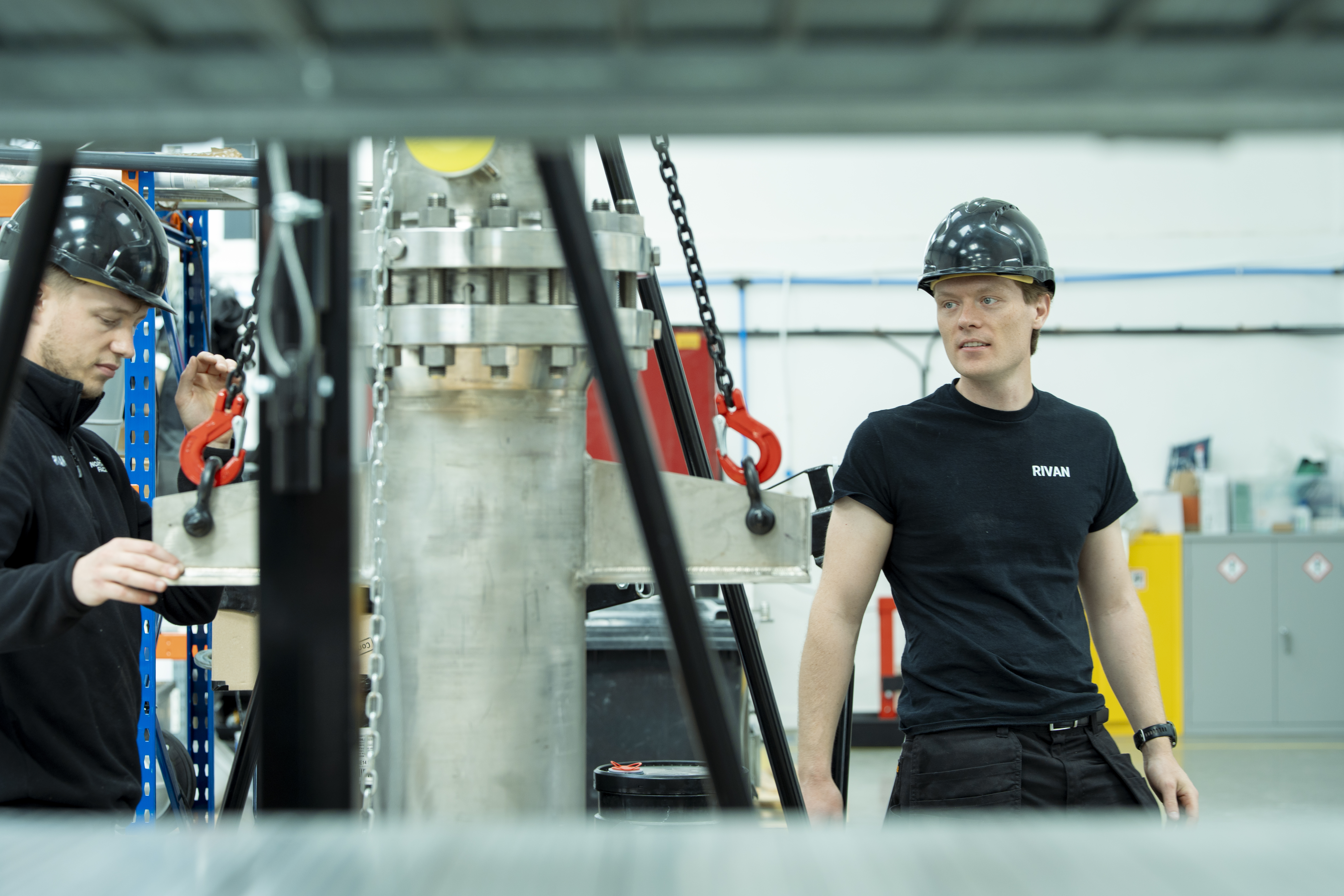
- Our V2 reactor was designed, engineered and tested entirely in-house. Whilst this reactor was fabricated externally for speed and safety, future design iterations will be made entirely in-house. This highlights a core tenet to Rivan’s strategy, built on vertically integrated engineering and manufacturing to increase iteration speed and decrease cost.
Massimiliano Materazzi, Associate Professor of Chemical Engineering, UCL:
“Rivan achieving these levels of product purity and system performance with a variable-flow of inlet CO2 and green hydrogen is a big milestone for the power-to-x industry, and credit to both the UCL and Rivan team for the hard-work over the last 12 months!”
The true impact of this milestone emerges when Rivan is viewed as a vertically integrated system – from DC solar through to gas-grid injection. Alongside our reactor, we design and integrate the following:
- Variable, low-pressure H2 via Electrolysis
- Variable, low-pressure CO2 via DAC
- Off-grid DC solar
Every sub-system is designed and manufactured in-house, enabling seamless integration with our reactor to achieve consistent GS(MR) performance. The Rivan system has no external feedstocks other than rainwater and sunlight, removing 3rd-party dependencies faced with biomethane and other SNG or synthetic fuels producers. The second a photon hits our solar array, energy flows smoothly into hydrogen generation, CO2 capture, and into Synthetic Natural Gas production before entering the UK’s gas-grid.In this sense, Rivan can be thought of as a chemical battery, enabling both the transfer of energy through space (distance) and time (storage capabilities).
Our V3 reactor will build on these learnings, delivering higher performance, lower costs, and a ten-fold scale-up to 1 MW. Deployment is planned before the end of 2025.
